FUNDING PROPOSAL SECRETS - A FOREWRIGHT INSTITUTE INITIATIVE
Stop Wasting Precious Time Changing Sentences That Don’t Make A Difference On Getting Funding
Live Webinar Reveals:
How A Rejected Harvard PhD Applicant Ended Up On The Other Side Of The Table, Reviewing 500+ Funding Proposals And Helping Secure $18M+ In Funding.
It took an unpaid internship to learn one skill I didn't know I was missing.
That skill eventually took me from being the applicant who was rejected...
to sitting on the other side of the table, evaluating proposals myself.
I've since reviewed more than 500 funding proposals.
And something became painfully obvious:
The things applicants spend the most time improving are often not the things evaluators use to decide whether a proposal deserves funding.
You've probably done this before.
You finish the proposal.
Read it again.
Find a sentence that doesn't sound quite right.
Rewrite it.
Read it again.
Ask someone else to read it.
They suggest a few changes.
You make them.
And eventually you have a proposal that sounds better than the one you started with.
But you still don't know whether an evaluator will fund it.
There's a reason for that.
And it has almost nothing to do with how good your writing is.
You've been treating the proposal like something that needs to be perfected.
So when something feels weak, you improve the sentence.
When the argument feels unclear, you explain it more.
When you're worried the proposal isn't impressive enough, you add more evidence.
All of that feels like progress.
But there's a problem.
You're improving the proposal according to the way you experience it, not according to the way an evaluator experiences it.
The Proposal Can Be Brilliant And Still Lose
Because there's something evaluators are scoring that has nothing to do with how intelligent your idea is, or how polished your writing is.
And you probably aren't looking for it because you're approaching the proposal from the wrong side of the table.
I Learned This From Being On The Wrong Side Of The Table.
My name is Paulius Yamin.
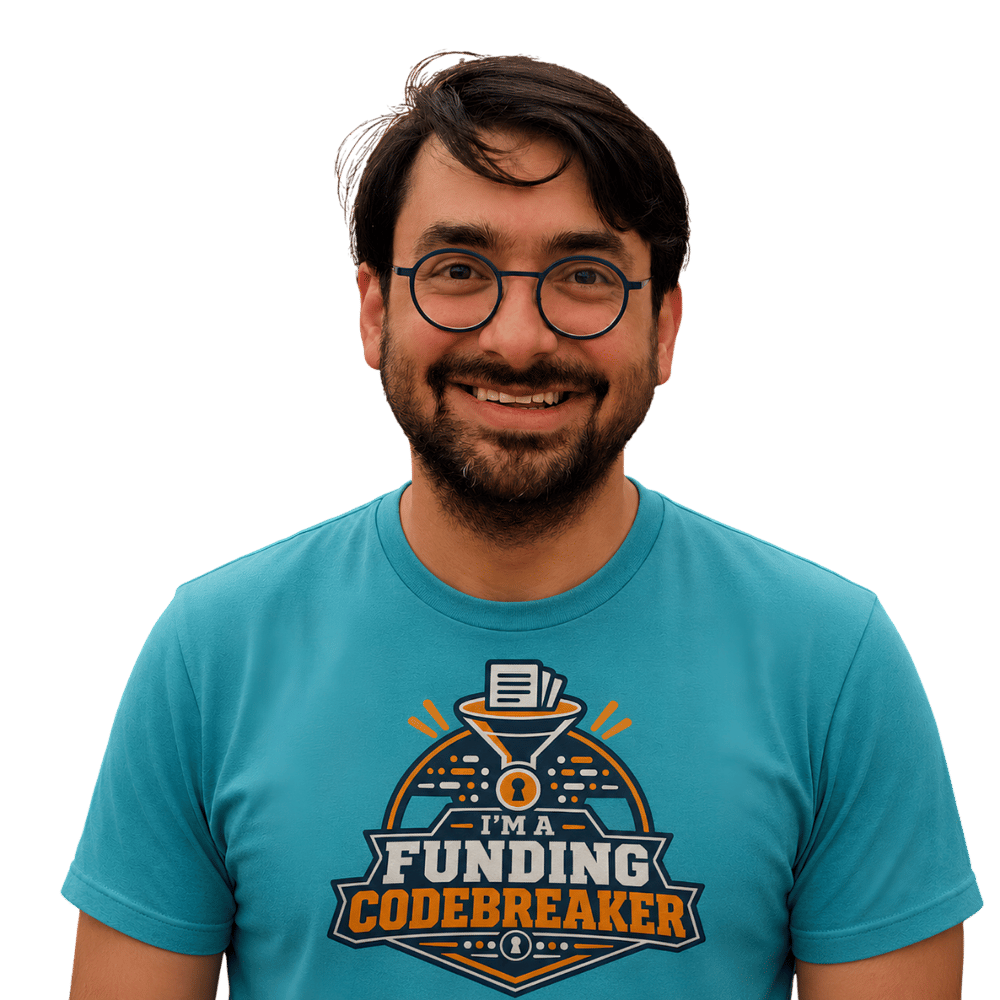
It took an unpaid internship to learn a skill I didn't know I was missing.
That skill eventually took me from being the applicant who was rejected...
to sitting on the other side of the table, evaluating proposals myself.
Before that happened, I had been rejected several times.
Two of the institutions that later gave me a seat at the table had previously told me no.
Harvard rejected my PhD application.
So did the University of Pennsylvania.
Years later, I became a Policy Fellow at the Harvard Kennedy School.
And UPenn eventually made me Managing Director of one of its research centers.
The rejection is not the interesting part.
The interesting part was what happened after I crossed to the other side of the table.
I started seeing proposals differently.
Not because I had suddenly become a better writer.
But because I could finally see what happened after the proposal left the applicant's hands.
And I noticed something I had never noticed as an applicant:
The evaluator wasn't experiencing the proposal the way I was.
I knew what I meant.
I knew why the research mattered.
I knew how the pieces fit together.
The evaluator didn't have any of that.
They only had what was actually on the page.
And once I started seeing proposals that way, I noticed something else.
There was a part of the proposal applicants were spending enormous amounts of time improving that had very little to do with how evaluators were deciding what happened next.
I've now reviewed more than 500 funding proposals.
And became an evaluator for the European Research Council and the UK's Economic and Social Research Council.
Inside the webinar, you'll discover:
1. The First Thing They Look For
The first thing evaluators check has nothing to do with your writing or your credentials.
It's structural.
And it's visible within the first few seconds of looking at your proposal—before they've really engaged with your argument.
Most applicants don't even realize they're leaving this thing for the evaluator to figure out.
You'll see what it is, and why it changes the way an evaluator reads everything that comes after it.
2. The Brilliant Proposal That Still Loses
Why a proposal can be intelligent, well-written, and thoroughly researched, and still lose to one that looks less impressive on the surface.
The difference isn't necessarily the quality of the idea.
It can come down to what the evaluator is able to understand, believe, and justify from what's actually on the page.
And that's very different from what you, as the person who wrote it, already know to be true.
3. The Trap Behind "Just Keep Improving It"
Why the more familiar you become with your own proposal, the harder it can become to see what isn't actually on the page.
And what to do when you can no longer tell the difference between what the proposal says and what you know you meant it to say.
See Your Proposal Through An Evaluator's Eyes
Reserve your free seat for the live webinar.


The Forewright Institute and the Funding Proposal Secrets Initiative are operated by MB KP Investments.
Company code 307479353. VAT LT100019473018.
Kazio Borutos g. 26-38, LT-08335 Vilnius, Lithuania, registered in the
Register of Legal Entities of the Republic of Lithuania (European Union).
Results described on this site are the outcomes of specific people in specific funding competitions.
Funding decisions are made by funders, not by us.
© 2026 MB "KP investments". All rights reserved.